Monday, January 27, 2014

January Uniform of the Month - War Correspondents

Will's typewriter, field desk and a stack of YANK magazines.  We had to set it up on two chairs this year - next year we'll get a table.
The guys wanted to see me draw something with a few more curves, so this is Julie Bishop, a YANK pin-up girl.
Some of the 84th Division "Railsplitters" getting prepared in the barracks.
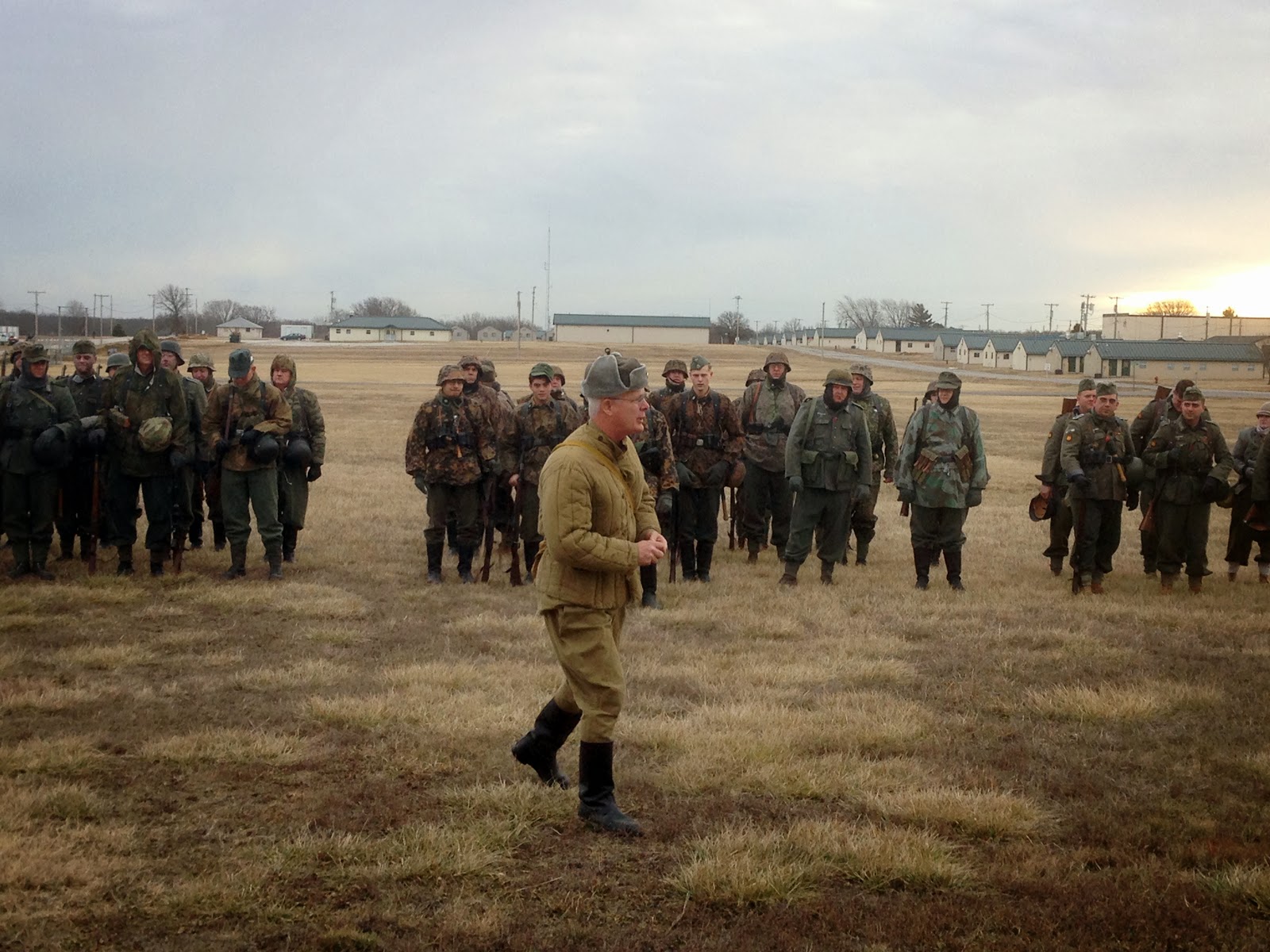
Our event coordinator, Dave Hruska, going over the details of the day to come. That furry Russian cap works well in the cold.  
Another Combat Correspondent from YANK Magazine.  He worked as a photographer throughout the day with a 1940's camera.
Will's all stuffed with goodies for the morning march.  He's wearing some spiffy new M1939 Leather Riding Gloves.
Another shot of Will as we march to our first scenario of the day.  He has a M1938 Map Case and a Transitional Lightweight Gas Mask Bag.
Some of the Railsplitters stopping along the roadside near Recht.  The sun came in and out all day long.
This is me working on a sketch out in the field.  I found it very challenging as guys were constantly moving from place to place.
Associated Press writer, Will Green, takes a break from the action.  Note the green Correspondent's Brassard on his left sleeve.
Life Magazine Combat Artist, Eric Krelle, grabs a drink just northeast of Recht.  He is wearing a M1936 Musette Bag on his left hip.
The 84th Division men prepare to move out.  Most are wearing the M1943 Field Jacket with Wool Trousers and M1943 Combat Boots.
Looks like Will is trying to fall in with the Germans... wrong side buddy!
We got a fire going to cook a few K-Rations between scenarios.  Some of the Railsplitters know that hot chow is better than cold chow.
Will's only weapon in the field, a M1917 Bolo Knife.  And man, what a knife!
Our Canadian friends wearing their Denison smocks and Scrim Scarves, also known as Face Veils.  I love their uniform!
Private James Welborn takes a breather during a lull in the action.
Will's second fire of the day in the town of Recht.  What happens every time Will gets hungry - he just makes another fire!
A black and white photo of some soldiers in the town of Recht.
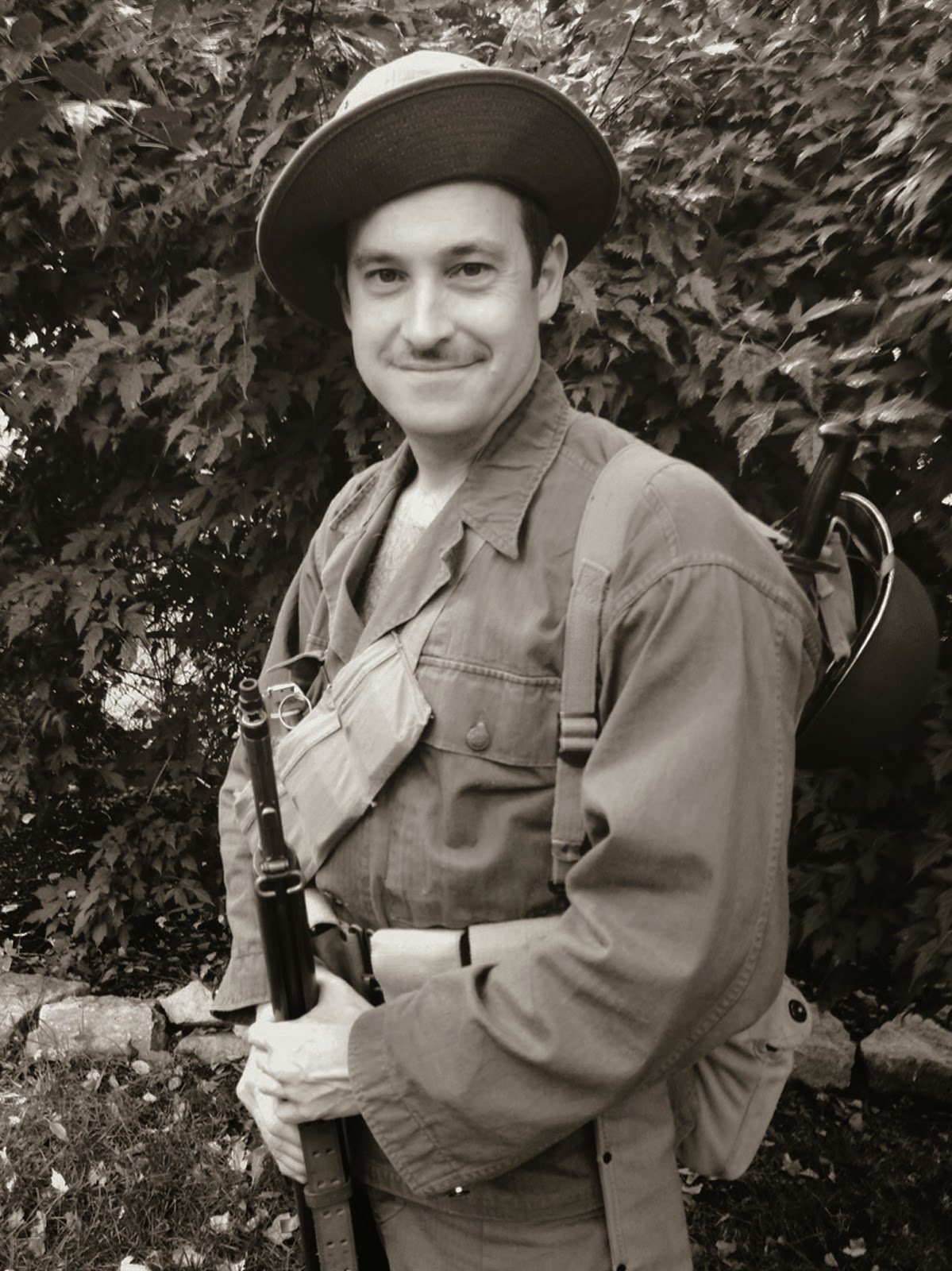
A battle-hardened, yet smiling Combat Artist late in the day.  Yes, that's a pretty fine mustache indeed.
Last photo of the day, the Railsplitters waiting for orders along the roadside.

Wednesday, December 18, 2013

December Uniform of the Month - The Battle for Elsenborn Ridge

Private Sill and Sergeant Rowe head into the woods around Elsenborn Ridge.  We started working on our positions around 1500 hours.
Sgt. Rowe begins work on our foxhole.  The initial inch or two of ground was frozen solid and took quite a bit of effort to break through.
Pvt. Sill and Pfc. Green working on their position.  The larger pick mattock came in handy.
Sgt. Rowe and I decided to go with the classic slit trench.  Our hole ended up about 7 feet long and about 30 inches wide.
Private First Class Krelle using a folding shovel on the foxhole.  We were actually quite proud of our work.
Pfc. Green tests out his foxhole.  You can get pretty warm while digging, so a field jacket isn't always necessary. 
Heating up a can of K-Ration ham on our campfire.  Warm food always tastes better on a cold night.
A night shot of Pvt. Sill preparing to move out.
This is the only known photo of our night patrol.  We worked our way down the creek bed as far as we could go.
My helmet with the 2nd Division's "Indianhead" insignia on the front and a gas mask bag used to carry supplies.
Hunkered down in our foxhole, Sgt. Rowe is heating up some water on our little alcohol stove. 
The sergeant gets a call from the other foxhole on one of our field telephones.
A great photo of Private Sill trying to warm up by the fire after our patrol.  It got down to 14 degrees overnight.
This one is just funny... checking my photos on an iPhone in my foxhole.  Well, we were authenticity minded most of the time.

Thursday, November 14, 2013

November Uniform of the Month - Battle of Ia Drang Valley 1965

Proudly wearing the OG-107s, the uniform that the U.S. Army went to Vietnam with in 1965.
The Battle of Ia Drang was the first major battle between regulars of the United States Army and regulars of the People's Army of Vietnam (PAVN/NVA) of North Vietnam during the Vietnam War. The two-part battle took place between November 14 and November 18, 1965, at two landing zones (LZs) northwest of Plei Me in the Central Highlands of South Vietnam as part of the U.S. airmobile offensive codenamed Operation Silver Bayonet. The battle derives its name from the Drang River which runs through the valley northwest of Plei Me, in which the engagement took place. Ia means "river" in the local Montagnard language.

Representing the American forces were elements of the 3rd Brigade, 1st Cavalry Division: the 1st Battalion and 2nd Battalion of the 7th Cavalry Regiment, and the 2nd Battalion, 5th Cavalry Regiment of the United States Army, facing elements of the B3 Front of the PAVN (including the 304 Division) and Viet Cong. The battle involved close air support by U.S. aircraft and a strategic bombing strike by B-52s. The initial Vietnamese assault against the landing 1st Battalion, 7th Cavalry at LZ X-Ray was repulsed after two days and nights of heavy fighting on November 14-16. However, the follow-up surprise attack on November 17 that overran the marching column of 7th Cavalry 2nd Battalion near the LZ Albany was the deadliest ambush of a U.S. unit during the course of the entire war. About half of some 300 American deaths in the 35-day Operation Silver Bayonet happened in just this one fight that lasted 16 hours. 

The battle was documented in the CBS special report Battle of Ia Drang Valley by Morley Safer and the critically acclaimed book We Were Soldiers Once... And Young by Harold G. Moore and Joseph L. Galloway. In 2002, Randall Wallace depicted the first part of the battle in the film We Were Soldiers starring Mel Gibson and as Col. Hal Moore.

This has been one of my all-time favorite uniforms for many years now.  It is a sharp looking uniform with a very smart military appearance.  Once I built my M-16A1 replica, I was finally able to put this impression together.  Thankfully, our friends' backyard served as a very nice substitute for the Central Highlands of Vietnam in mid-November.  It is an extreme honor to wear the same uniform that the 1st Air Cavalry went into combat with for the first time in Vietnam.  Garry Owen!


The MX-911/U angle-head flashlight is attached to the front of my suspenders.  This is a good view of the M1956 Universal Small Arms Pouch.
The distinctive patch of the 1st Cavalry Division is the largest patch in the U.S. Army.  Also seen here is an M18 Red Smoke Grenade - a replica that I made myself.
Back view showing the M1961 Combat Field Pack (Butt Pack) and a good view of the M1956 Suspenders.
A crouching trooper ready for combat.  Note the Mitchell Pattern camouflage helmet cover.
The OG-107 jacket features the gold-on-black US ARMY tape and the black-on-white name tape.  Headgear is the "baseball" utility cap.
Footwear for Airmobile units in 1965 was the 10" black leather Jump Boots.  These are Corcoran boots.
My full assortment of field gear for this impression.  The rifle features the original three-pronged "duck bill" flash supressor.
Another shot of me in the Central Highlands of Vietnam.  Note the chincup of the M1-C  Parachutist's Helmet.
The real Colonel Hal Moore (left) and Sergeant Major Basil Plumley (right) of the 7th Cavalry at the Battle of the Ia Drang Valley.

Wednesday, October 9, 2013

October Uniform of the Month - Merrill's Marauders

Each Marauder styled his Daisy Mae HBT Cap in a unique shape to fit their own personal tastes.
Merrill’s Marauders, named after Frank Merrill, was officially named the 5307th Composite Unit (Provisional).  It was a United States Army long range penetration special operations jungle warfare unit, which fought in the China Burma India Theater of World War II, or CBI. The unit became famous for its deep-penetration missions behind Japanese lines, often engaging Japanese forces superior in number.  In slightly more than five months of combat, the Marauders advanced 1,200 kilometres (750 mi) through some of the harshest jungle terrain in the world, fought in 5 major engagements (Walawbum, Shaduzup, Inkangahtawng, Nhpum Ga, and Myitkyina) and engaged in combat with the Japanese Army on thirty-two separate occasions, including two conventional defensive battles with enemy forces for which the force had not been intended nor equipped. Battling Japanese soldiers, hunger, fevers, and disease, they traversed more jungle terrain on their long-range missions than any other U.S. Army formation during World War II. The men of the Merrill's Marauders enjoyed the rare distinction of having each soldier awarded the Bronze Star. In June 1944, the 5307th Composite Unit (provisional) was awarded the Distinguished Unit Citation. On August 10, 1944 the Marauders were consolidated into the 475th Infantry. On June 21, 1954 the 475th Infantry was re-designated as the 75th Infantry; thus Merrill's Marauders is the parent of the 75th Infantry Regiment, from which descended the 75th Ranger Regiment.

This was a pretty exciting uniform to assemble for October.  I am leaving on a business trip to China on October 14, so I thought it was a timely impression to pull together and one that I could assemble quickly.  The only October reference I could find for the unit was that the men were sent to India arriving in Bombay on October 31, 1943 for training.  The unique components of this uniform are the HBT Daisy Mae Hat, the HBT uniform with leggings worn under the trousers, the Jungle First Aid Kit and a Machete. Upon seeing the photos of myself there is quite a bit of swagger associated with this unit and its uniform.  I think that the manner in which each soldier in the 5307th customized his uniform, especially the way they wore their HBT caps, gave them a very distinctive look.

The Jungle First Aid Pouch hangs from the right side of the cartridge belt.
Attached to the Haversack is an M1 Bayonet in an M7 Scabbard.
On my left hip is the canvas Machete Sheath and a 1942 Machete. 
This Machete is ready for business.  Hanging from my chest pocket is a MK-II Fragmentation Grenade.
Marauders frequently affixed their steel M1 Helmet to the back of their Haversacks.
A smiling Marauder in the jungles of Burma.
The real Merrill's Marauders resting outside of Nhpum Ga in Northern Burma, circa late March or early April 1944.